One of the more unique hobbies that I am involved in only
has maybe on the entire planet around 2000 enthusiats. I build from scratch,
scale models of lighter than air ships, more specifically the huge rigid dirigibles that flew from 1900 to 1938. These
huge aircraft were usually at least 420' to over 800' in length. They are not
ships from some sc-fi action movies. These ships actually ruled the skies
during the earlier parts of the 20th century. These airships had more than
their fair shares of accidents due to ignorance, of weather conditions, and
just plain stupidity on how these ships work. When most people think of these
"zeppelins", they get images
of the "Hindenburg", ship designation LZ-129. Nobody knows what really
caused it. But I do know this, if it would had been filled with helium, as Hugo
Eckener, successor of inventor and founder, Count Ferdinand Von Zeppelin of the Luftschiffbau
Zeppelin Company, had the ship designed, it never would have exploded.
But that is only one chapter (the final one) in the rigid
airship story.
During the 1920's, the US Navy was looking at rigid airships
to use as long range recognisance aircraft of the Atlantic and Pacific oceans.
Since airplanes in those days had such short ranges, the thought of using the
large rigid airships as recognancance lookouts, and flying aircraft carriers,
to be able to launch and retrieve airplanes while in flight, was considered.


In 1924, Germany was ordered to pay war reparations to the
allied countries they fought against in WWI. During the war, they perfected and
used their rigid airships, built by the Luftschiffbau Zeppelin company, for
long range bombing runs over France, and Britian, as well as some other
countries. When the war was over, the remaining ships were divied up amongst the allied countries. After they were all
handed over, they were still one short. So the Zeppelin company was
commissioned to build one more ship, the "LZ-126". Eckener,
himself captained the ship across the Atlantic, and delivered it to the
head of the US Navy himself.(Let it be known that later on in the 1930's that
Eckener had a DEEP hatred for the Nazi party and everything it stood for, but
that is another very complicated story that led up to the ultimate end for
these types of aircraft, notably, the destruction of the LZ 129
"Hindenburg" on May 6,1937.)
.jpg)
Back to the LZ 126. After the Navy took control of this
ship, it was drained of it's hydrogen lifting gas, and filled with non
explosive helium. It was designated the ZR-3, the USS "Los Angeles".
She was about 660' long and 91' in diameter at the widest part of her hull.
the Navy used this ship as an experimental platform to see
how practical it would be to launch and retrieve airplanes in flight while on
long range missions. The Navy had this
ship they were using at the time, as well as an earlier ship, that they had
comissioned and built themselves at Lakehurst Navel Air Station in 1923, the
USS "Shenandoah", the ZR-1. This first US made rigid airship
pioneered the use of helium in it as opposed of explosive hydrogen for it's
lifting gas. This first airship was used more as a publicity recruiting tool to get young men to enlist in
the Navy Air Corps, as I believe it was originally called. The US Air Force was
not in existence yet.


The "Shenandoah" was a graceful, majestic ship, if
there ever was one. At 682' long, and 79' in diameter at the widest part of her
duralumin framework hull, at the time, she was the largest dirigible in the
world. (Ultimately, in 1936, the Hindenburg was and is still the largest
aircraft that ever flew, at 804' long, and a max hull diameter of 135'!!.
That's almost 3 football fields in length.)
In order to meet a very strenuous publicity schedule in
1925, the "Shenandoah" was taken out in weather it should never had been. With little
weather detection technology, and the ignorance of the higher up Navy brass
insisting on pushing the "Shenandoah", against the ship's captain's objections, on this city to city publicity
tour schedule, the ship was ripped apart in a thunderstorm near Ava, Ohio, in the early morning of
September 3, 1925. 14 of the crew were killed. The ship's complement was 40
(officers and men). But the ship proved one thing. If the ship would have been
filled with hydrogen,the loss of lives would have been much greater. The ship was torn into 3 main pieces in a
very violent updraft in the center of the storm, and after this happened, the
remaining crewmen still on board,"free ballooned" valving helium for
a more or less controlled descent, the
different hull sections to the ground. The bow landed 10 miles away from the
stern. The control car ripped from the ship and plummeted to the ground,
killing everyone that was in it, including the ship's captain, Lieutenant
Commander Zachary Lansdowne.

The stories of these great "ships of the sky" is a
very romantic one full of tragedy, and triumphs, and a fascinating part of
aviation history. These ships make today's modern 200' long blimps look like
toys by comparison. And you can't get inside the envelope of a blimp like you
were able to get up inside the framed hulls of these huge ships for in flight
maintenance work.
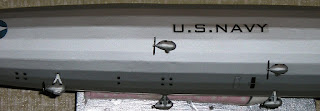

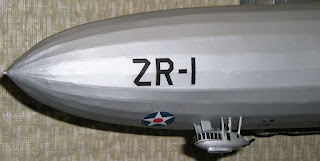
In November of 2008, I decided that I wanted to build a
scale model of the ZR-1 "Shenandoah". Since model kits of most of
these ships do not exist for most part, I decided to build one from scratch. I bought a one
page paper plan from a guy on eBay, "Plans and Things". After
extensive internet and book research, I built the thing using the balsa wood
bulkhead "ring and keel" method, and 1/16" X 1/16" balsa longitudal stringers to
complete the outside shape of the frame. I covered it with tissue paper, then
sealed it with flying model aircraft dope, then after I carved and shaped the
control,and engine cars, as well as the fins, I spray painted the whole model silver. I made my own decals
for the thing to finish the model off. I kept track of the work time I put in
the model. It took a period over 5 months, with 99 hours of actual labor build
time to complete in March of 2009. This was the first scratch built model
airship I had built since 1973. Yes, they are that complex to build. I have
7 surviving scratch built model airships
I did like this. This one came out the best. A LOT of work, though.
Images of my model are interspaced with photos of the actual dirigible. The top image, image #5, and image #7 are images of my model that I reworked using cut and paste,Windows Paint, and Paint.net.
The model is 1/388 scale,
about 22" long.
Jim.


.jpg)


