Friday, September 21, 2012

"610"

 This is "610". A fanciful rendition of a typical 1880's Lancaster, PA townhouse similar to one I lived in as a kid from 1964 through 1969. Although the actual house in Lancaster, at the time was not as fancy as this model, I did maintain the floor layout and foundation footprint design of the original house. This is the first of two scale model buildings that I have built that are fully finished (no furniture except in the kitchen) inside and out, with finished rooms, a grand staircase, and working interior as well as exterior doors. I built this model in 1976 out of scrap cardboard that I drew and painted up to look like brick, as well as balsa wood window and door frames. I had just gotten done reconditioning this model last year as some of the white cardboard features were really turning yellow with age, so I painted them white, and corrected some roof mouldings I did not do right the first time in '76. I also totally repainted the dormers, as these were really aging bad. The model is approximately 1/32 scale, and is BIG! It is 8 inches wide, 18 inches deep, and 11 inches high at the double chimneys.
 Three-quarter rear view showing kitchen/master bedroom and balcony "wing" Since this picture was taken, I have relaminated and painted the outside cellar door gray, as typical for these houses in the city in the mid twentieth century.
 Looking through the front door at the main staircase, up the steps to the master bedroom. The doorway at the end of the hall along side the staircase is open into the kitchen. Kind of hard to photograph this, though. Remember I made this model mostly out of scrap cardboard, balsa wood, acetate plastic for the window glass, and construction paper for the interior wall coverings. The "carpeting" was made from an old small floral print dress my mom had back then.
Through the hallway kitchen doorway, we can see a really ugly "space age" dining table and chair set in the kitchen. Sitting behind that on the south wall, is the range, and to the left of that is the end of a big white metal kitchen sink cabinet.


Looking from the front door down the hall past the staircase, through the doorway into the kitchen. The doorway to the left goes into what was a formal dining room, but we used it as our television viewing room.  Not visible in this picture, as soon as you were in the front door, there was a door immediately to the left off the hallway that led into the front room. We used this room originally as a formal living room, with the TV in there at first. After we moved the TV into the middle room, this front room became the stereo, and sitting room. The front  room and middle room were joined together by a doorway in between them as well as to the hallway. Finally about 2 years before we moved out, this front room became my parents first floor bedroom, and my sisters got the upstairs master bedroom over the kitchen. I then got the bigger middle bedroom, and the front bedroom, seen here replicated in this picture, became a storage room.
 A peek through the front second floor bedroom windows at the northeast front bedroom (looking dead on at the front of the model, the left two windows on the second floor). Visible are the closet door, and the open doorway into the middle bedroom, as well as the floral "carpeting" that I used to cover the floors of this model. Also visible on the baseboard is an "electrical outlet", and on the doorframe a "light switch" for the room "ceiling light fixture", which I did not put any of these in any of the rooms of this model.
 View looking at the backside of the house at the southwest corner.
 Here is yet another different view right before I started the repair/(re)paint work to the 36 year old model. You'll notice the spindly dilapidated black railings, made originally out of balsa strips on the front stoop steps in this picture have since been replaced with two pieces of clear styrene plastic that I detail painted with very narrow strips of black paint to give the appearance of wrought iron railings. The drooping outside door lights have been rebuilt and repainted, too, since this image was taken, as well. The first image I posted of the front of this model shows those repairs.

Unique view of the south side of the building. You can see the triple chimney setup that this place had, including the (south) kitchen hearth chimney, which while the actual house still had this chimney when I was a kid, it was non functional as this fireplace was long gone. As a matter of fact, all the fireplaces this house had were all ripped out and long gone, as only the east gable chimney was still functional. It was hooked up to a coal furnace in the dirt floor basement that had been converted to be an oil fired furnace sometime in the 1950's which in turn was rigged up to a hot water baseboard heating system for the house. It had no cast iron radiators, like one would think a house of this vintage would have. I believe the west gable chimney was always a faux chimney, as the wall where this chimney is mounted to is where in the real house, the staircase is there, and that chimney was noticeably narrower than the east one. It was placed there to maintain an artistic symmetry of the house's roofline.
 Head-on view of west side of the model.
East side of the model, as what one would have seen from the side yard that the actual house had. (Sorry, I thought this photo was posted but misplaced it when I was doing this post. Here it is now in it's proper place.)

North side , or street front view of the house. The daylight shining through the attic fanlight dormer windows is a cool effect.
Second floor balcony detail shots. Design is in typical urban 1880's -1890's townhouse style. I used straight pins that I cut off with oversize round pin heads as light globe fixtures above the kitchen door, and master bedroom door on the balcony. Typical 1920's- 1930's electrical refit light fixtures for these old houses.

Light shining through attic dormers.
Rear south facing dormer, and roof shingle detail, as viewed if one were standing on the very south end of the flat "tar paper" roof. Shingles were made from acid free heavy gauge paper that I spray painted  two 8-1/2" X 11" sheets flat black, then I cut them into even strips. Then each strip, I notched half way up with vertical cuts at fixed regular intervals. Then I glued them on the roof, overlapping them half way the total width of the strips so that only the notch was showing, and staggering the notches to give the effect of individual shingles. As you can see, the look of the texture is about perfect for the scale of this model! Even though this model is kind of scruffy compared to my later stuff, it is a cool model of one of my favorite childhood homes, albeit the way my mom and I wanted it to look if we would have been able to buy the house and remodel it to our likings.
My daughter just took this picture of me holding the model, today, after I did more clean up and repaint work on the thing.  Specifically the evening up of the edges of the roof shingles at the edges of the roof. The trim job I did at the edges of the roof was a little sloppy, so I evened them up using an X-acto knife with a No.#11 blade in it, as well as using an emory board to help flush up the edges. After that, I touched up the edges with flat black paint, and the model looks alot better now, at the roofline. I also dusted the thing off. It gets dirty fast, in my house. It has been on continuous display since I completed it in 1977, so it is only natural that it needs some maintenance work, much like a real house.
 These three pictures I just added, as I just got done redesigning, and restoring the model's baseplate, with a new baseplate that is made out of 1/4" plywood that I laminated cardboard to, so I could rebuild, and add to the house's  "concrete" walks around the two sides of the structure. The wider base allowed me to add an adjoining walkway along the east side of the house to join the concrete "patio" at the kitchen door under the balcony with the walk that is on the streetside front of the house. I used "Polly" brand model railroading paint in a concrete color to give the old yellowed cardboard "concrete" a uniform, more concrete color with the new side walkway I just installed on the model.
The new look continues along the west side of the model, as the plywood underneath that long wall was also laminated with cardboard, and painted with the same concrete paint to make the house look like it has a foundation, now. Painting almost all the remaining exposed cardboard surfaces will also keep anymore silverfish from damaging the model, as silverfish like to munch on old cardboard. The front stoop steps had some very minor superficial  surface damage from them. Since I painted the stoop steps, that should put a stop to that. Silverfish don't like paint.
These new additions and renovations to this old model make it now look like I just built the whole thing now, instead of it looking like it was built in 1977. It will also allow me now to securely anchor the model in a wood and plexiglas dust proof display box, which I am in the process of building right now. This will not only keep anymore dirt from getting on the model, but it will also protect it from getting hit by any objects that may accidently fall near it. It will also stop me from doing stupid stuff to it, like I used to sit stuff up on the flat "tar paper" roof of the thing for storage purposes and/ or because of lack of room, or just for "fun". If it is taken care of, the plexiglas display box should keep this model nice for many years to come, long after I'm gone.
Update. October 5, 2012. 610's new wood and plexiglas protective  display box is complete, and model will not suffer anymore dust and silverfish damage, as well as hit damage, to boot. Old model looks fantastic with it's new "concrete" walkways and concrete painted stoop steps, now. Everything is clean, and what is supposed to be white is white, again, not an ugly yellow/brown. Other than some minor tweaking I need to do yet to the display box, itself, I consider the restoration work on this model to be complete. Anymore work to the model itself would destroy the original 1976 design character of the structure that I originally came up with back then.

Jim.

Monday, September 17, 2012

Rockford Plantation house miniature.

Maple wood model of the Rockford plantation house in Lancaster I made while I was working at Sensenich Corporation, wood products division, at Lancaster Airport in 1977. most details are hand painted on after making the basic shape details of the house. Windows and doors are pieces of acid free paper that I hand drew the details on using what was the equivalent of a sharpie marker. Model is small. It will fit on the palm of my hand. The footprint of this model is about 5 inches by 3 inches, with the wraparound porches and such. Porch pillars were made by hand out of very small but long square strips of maple that I sanded round on a big belt sander, then cut to length to fit the porch height. Rockford House is a significant part of Lancaster County history as it was the home of General Edward Hand, involved in the Revolutionary War, around 1775 through 1784.
This model is not one of my better efforts, as I did this when I was 19 years old, and the model is based on some freehand sketches I did on site at Rock Ford plantation, itself on the south side of Lancaster City, PA, in what I believe in late 1977. The actual house was restored in 1960. The original bank barn that Hand built on the property had burned down a long time ago, but was rebuilt sometime in the 1980's.
 Nonetheless, for it's diminutive size size, it is a unique model, done in what some people would call in a "Folk Art" style.
 Backside.
Front. Note that I put the wintertime wooden window well covers where the basement windows are at. In recent years, these are not installed on the actual house, now. But at the time I built this model, they were there. If you are ever are in Lancaster County, Pennsylvania, Rockford Plantation is a very worthy historical site to visit. It is located on the very southern edge of Lancaster City.

Link;
http://www.rockfordplantation.org/index.htm

Jim.

Friday, August 10, 2012

1957 Chevy Bel Air 4 door Sports Sedan Hardtop 1/25 scale model-Revisited!

Beings that since I posted about this model back in 2010,  it has become my most popular post.  I thought I would revisit it with better, brand new digital photos of this model, that I just took, today. Now you can see this 1984 built AMT/Jo-Han scale model in somewhat more detail. It is a little over 8" long in 1/25 scale.
For these photos, I took the clear cover off the display box, and took the model outside to photograph it.
For a model that I built 28 years ago, I think it came out nice, and it still is very presentable! It is far from perfect but scale model kit builds of this body style of '57 Bel Air 4 door hardtops are practically non-existent.
 That is why I combined an AMT 1957 Chevy Bel Air 2 door hardtop kit with a Jo-Han/Ex-El products 1956 Pontiac Star Chief 4 door Catalina hardtop reproduction dealer promotional model to make this model.
Door lines on the body needed to be filled in and rescribed. Door handles needed to be shaved off and rebuilt in different spots.
The interior cavity opening in the body needed lengthened to accommodate the longer interior box and 4 door hardtop roof.  The back half of the interior box needed to be totally cut away, including the complete removal of the coupe rear arm rests, reconstructed, as well as lengthened, including rebuilding the package shelf, new rear door panels, new arm rests, as well as extending the width of the back seat, and making the coupe split back front seat into a sedan type solid back front seat. The window assembly came from a junked AMT original AMT 1957 Pontiac Star Chief Catalina 4 door hardtop friction promotional model. It fit my body shell without my having to modify it. I also added a turn signal lever to the steering column, as this is missing from the AMT kit. In that time period 1956 and 1957, Pontiac and Chevrolet shared the same hardtop roof sheet metal.
  The AMT '57 Chevy kit has the hood bar molded in as an integral part of the bumper grille assembly.

  
For this model, I cut the piece free from this assembly and attached it to the front of the hood as per the actual car.
A close up shot of this detail

This model is a replica of a yellow and white '57 Bel Air 4 door hardtop that I owned from 1980 through 1983. My dad made me sell it because he said that it was junk, and it would never be worth anything. I had alot of misgivings about this, but I was still "just a kid that did not know anything". so I did not really have a choice.The choices I did have were, either sell the car, or my dad would have booted me out of the house. There was no way that I could afford that, so I sold the car at a tremendous loss. My building this model was a consolation to me.
I thought you might enjoy seeing these images of this what I consider to be a nicer body style than the two door hardtop. I tried to open the hood to photograph the fully painted and detailed engine compartmet, but it was stuck shut. I have not opened it in about 15 years, and I was afraid if I would have used too much force, that I would have damaged the model. So I let it go.
                        So enjoy the images that I was able to take of this one of a kind model car.
Grille, and Chevrolet coat of arms on grille bar.
Let's zoom up on this view!
                                                 Oh, them cool '57 taillights!!

Here is the original post from 2010.

http://jayveejayaresjunk.blogspot.com/2010/11/1957-chevy-bel-air-4-door-sports-sedan.html


Jim.

Wednesday, August 1, 2012

1975 Buick Electra 225 Custom Landau Coupe, coming of age at last.

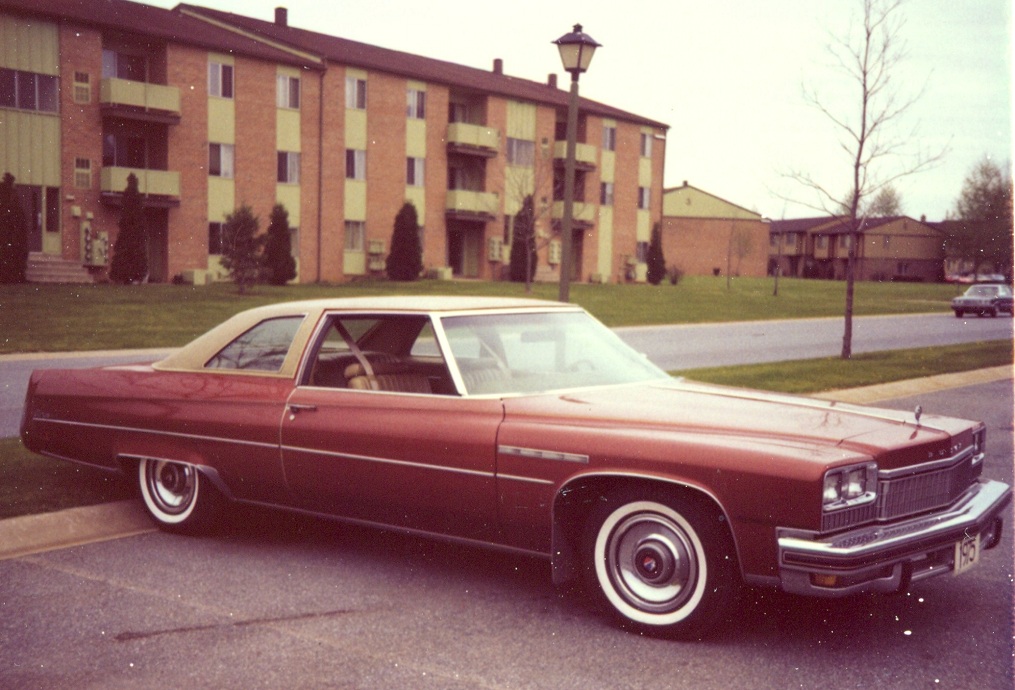
 As you may have figured out by now, I am a loyal fan of Buick. I have been ever since my dad and I went together to buy a green 1965 Electra 225 coupe in May of 1974.
In the ensuing years, in between me and my dad, we bought and drove five of these big Electras. In 1978, I bought what would be my first 1975 Electra coupe. See the three images, immediately below of this car.


I loved that car, nurtured it, and drove it until somebody broadsided me in it in early 1985. At the same time, my dad was driving this Landau coupe that he bought in 1982. The picture below is of my dad with this car after he first bought it.

When my insurance company totaled my car, I was devastated. My dad had compassion for me, and let me have his Electra for the insurance company's check that I got for mine. I have pretty much have kept it in storage, ever since.
 The car is all original, still wearing it's original GM applied paint, and vinyl Landau top, which the latter is still soft and pliable. The car has never been wrecked, and is absolutely rust free.Even at the bottom of the vinyl top where it meets the top of the quarter panels. NO bubbling under the vinyl at all, and NO rust holes in the metal right below the top mouldings.  I'll admit, the paint is tired, and chipped, but it is original, and presentable. The only real damage to the body is when my dad had the car parked along the street in the city when he owned it, it had gotten very lightly sideswiped in early 1982 shortly after he bought it, and damaged the body side moulding only, on the driver's door and rear quarter panel ever so slightly The paint was barely scuffed, but the underlying metal was not harmed. We used sheet metal screws to secure the mouldings back on the car. Not a very professional fix, but it kept them from coming off. You have to remember, back in the 1980's these were just used cars, not really worth anything on the market.

Finally today, these big mid seventies land yachts are beginning to get the respect they deserve, for what they truly represent. The end of an era of flamboyance and extravagance in American automobiles, which will be never seen again. Back in the 1980's I knew I had a duty, and foresight, to sit on this car to preserve it as an example of this bygone era. People all over the planet are beginning to collect these big old cars, as they do see the true beauty in these machines of that bygone era. 
But seeing that by time that huge cars like this were never going to be built like this, again, after my dad sold this one to me, I knew, I had to keep it long term, and keep it out of the weather, If I hoped to keep it in the condition that it was in when I got it in the mid 1980's. That is the way it looks pretty much, today.

The car is pretty much fully equipped. The only thing it does not have is a sunroof, but these are very problematic, anyway. The big 455 CID V-8 runs great, but the transmission needs serviced as it slips a little bit after it is totally warmed up. The interior is all original in maroon with white vinyl seats. It does show the wear of about a 5 year old used car. In other words, the interior is still very nice. It does have the typical cracking of the corners of the dashboard, and the big door arm rests. The driver's side of the split bench seat has a small 3" tear in it that could easily be repaired by a professional upholstery shop. For most part all the interior vinyl is still soft and plyable. The top of the dash is not cracked out all. Riding in this true full size Buick is like riding in a ship. So smooth and quiet. It is a totally different feel than the ride of a modern day automobile, a joy to drive, but it is a real handful. Beings that this was the last of four Electra's that I have owned, I'll probably NOT sell this car, until the time comes that my wife sells it at my estate sale, or I give the car to my son, as he already knows that truly rust free examples of these cars are as rare as hen's teeth. 

I hope to be able to post better DIGITAL pictures of the car soon when I get the time to get it out of storage, when I can find the time to do so. In the meantime, enjoy what an original condition '75 Electra 225 coupe is supposed to look like.

Scale model manufacturers need to get their butts in gear and start making models of this car, instead of always doing models of muscle cars. These big full size American cars from the mid 1970's ARE going to be the next hot sellers in the next couple of years, in my opinion.

Update; May 5, 2013. I just did a new post, with all new digital images of the car that I just took two weeks ago, in the end of April of 2013 with my digital camera after I pulled the car out from my garage to photograph it. Here is the link to the new blog post about this car.


http://jayveejayaresjunk.blogspot.com/2013/05/1975-buick-electra-225-custom-landau_5.html


Jim.

Pensupreme and other vintage milk cartons... do people collect these?

 In the last year, I have noticed how a lot of people collect vintage glass milk bottles, which I remember when I was a kid, how the milkman...